
Combination Tricast Explained: CTC Bets in UK Racing
 Available in US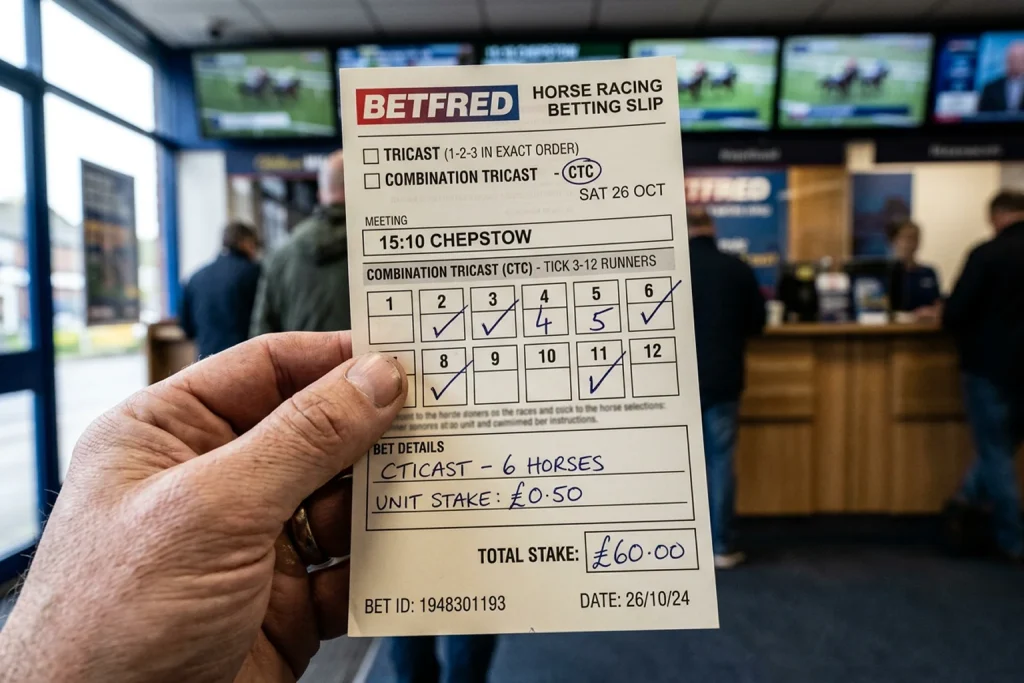
CTC Decoded
A combination tricast covers all possible finishing orders of your selected horses across the first three positions. If you select three horses, the combination tricast includes all six permutations of how they might finish first, second, and third. This structure removes the burden of predicting exact order while maintaining the requirement that your horses fill all three places.
UK bookmakers use various terminology for this bet type. “Combination tricast” or “CTC” appears on many betting slips. “Tricast box” describes the identical bet structure. “Any order tricast” communicates the same concept. These terms are interchangeable; understanding that they mean the same thing prevents confusion when betting with different operators.
The combination tricast represents a middle ground between straight tricast difficulty and broader exotic bet types. You must still identify three horses that will fill the frame, but you gain flexibility on their specific order. This structure suits situations where you have strong opinions about which horses will place but uncertainty about precise finishing positions.
The bet type has evolved with the industry, becoming easier to place through modern betting interfaces while retaining the same fundamental structure that has existed for decades. Digital platforms now handle the combination calculations automatically, removing the manual arithmetic that once complicated CTC betting.
CTC decoded: one bet type, multiple names, consistent mechanics across all UK bookmakers.
Combination Tricast Explained — More on this topic at trifecta box bet.
How CTC Works
The combination tricast generates multiple individual bets from a single selection. The formula for calculating combinations is n × (n-1) × (n-2), where n represents your number of selections. Three horses produce 3 × 2 × 1 = 6 combinations. Four horses produce 4 × 3 × 2 = 24 combinations. Five horses produce 60 combinations.
Each combination represents one possible finishing order. A three-horse CTC on selections A, B, and C covers: A-B-C, A-C-B, B-A-C, B-C-A, C-A-B, and C-B-A. Your ticket wins if any of these six orderings occurs. The payout reflects whichever specific ordering the race produces.
Your unit stake applies to each combination individually. A £1 three-horse CTC costs £6 total (6 combinations × £1 each). A 10p four-horse CTC costs £2.40 (24 combinations × 10p each). Understanding this multiplication prevents surprises at the betting window.
According to Betting.co.uk, the combination tricast is available from all major UK bookmakers on qualifying races. Races must meet minimum field size requirements, typically eight or more runners with at least six starting for Computer Tricast calculations.
Only one combination from your ticket can win. If A finishes first, B second, and C third, your A-B-C combination wins while the other five lose. You receive the declared dividend for the winning combination only; the losing combinations within your box return nothing.
The dividend you receive matches what a straight tricast on the winning combination would pay. A CTC provides coverage across orderings but does not change the payout for any specific ordering. You pay more for broader coverage; you receive the same dividend when you win.
Cost escalation accelerates rapidly with additional selections. Six horses produce 120 combinations; seven horses produce 210; eight horses produce 336. Before adding selections beyond five horses, calculate whether the increased coverage justifies the proportionally higher cost.
Placing a CTC Bet
Online betting platforms simplify CTC placement substantially. Most sites feature dedicated exotic bet builders where you select your horses, choose “tricast” or “tricast box” as the bet type, and specify your unit stake. The platform calculates your total cost automatically before confirmation.
The bet slip clearly shows combination count and total stake. A five-horse tricast box displays “60 combinations” and multiplies your unit stake accordingly. Review this information before confirming to ensure the total cost matches your intention.
On-course betting requires clearer communication. Tell the Tote operator you want a “combination tricast” or “tricast box” on your selected horses. Specify your unit stake per combination. The operator enters the bet and confirms the total cost before you hand over money.
Traditional betting slips at bookmaker shops include CTC options. Mark your selections, tick the “combination tricast” or “CTC” box, and enter your unit stake. Some slips require you to manually calculate and write the total; others calculate automatically. Check the slip carefully before presenting it.
Mobile apps offer the most streamlined experience. Most racing-focused apps feature one-tap exotic bet construction with clear cost displays. Push notifications confirm your bet placement and remind you of results, creating a comprehensive mobile betting experience.
Consider your maximum loss before placing any CTC. A seven-horse box at £1 per combination costs £210. Ensure this amount fits within your allocated exotic betting budget. The combination count escalates rapidly with each additional horse; understand the cost before committing.
Keep records of your CTC bets. Note the race, selections, combination count, total cost, and outcome. Over time, this data reveals patterns in your successful and unsuccessful betting, guiding refinement of your selection process.
CTC vs Other Terms
Several terms describe identical or very similar bet structures. Understanding the relationships prevents confusion when reading content from different sources or betting with different operators.
“Tricast box” and “combination tricast” mean exactly the same thing. Both cover all orderings of your selections across first, second, and third places. Choose whichever term your preferred bookmaker uses; the bet works identically.
See also Favourite in Trifecta Box.
“Trifecta box” typically refers to the pool-based version of the same structure. Where “tricast” usually implies Computer Tricast dividends calculated from starting prices, “trifecta” usually implies Tote pool dividends. The box concept—covering all orderings—remains constant.
“Any order tricast” explicitly describes what CTC provides. This terminology appears less frequently but may help clarify the bet type for punters unfamiliar with “combination” or “box” terminology.
“Full cover tricast” sometimes appears but can create confusion with full cover accumulators. The term accurately describes covering all combinations but lacks the precision of “combination tricast” or “tricast box.”
American terminology uses “trifecta box” almost exclusively. If you read US-origin content about exotic betting, translate “trifecta box” to “combination tricast” or “tricast box” for UK betting purposes.
Key box and part wheel terminology describes variations on the full CTC where some horses are restricted to certain positions. These structures reduce combination counts while sacrificing some coverage flexibility. They deserve separate treatment but share the same foundational concept of multiple orderings within a single bet.
Regardless of terminology, the underlying mechanics never change. Select your horses, pay for all possible orderings, receive the declared dividend if any of your combinations wins. The name matters less than understanding how the bet functions.
