
Straight Trifecta vs Box Trifecta: Cost, Risk and Reward Analysis
 Available in US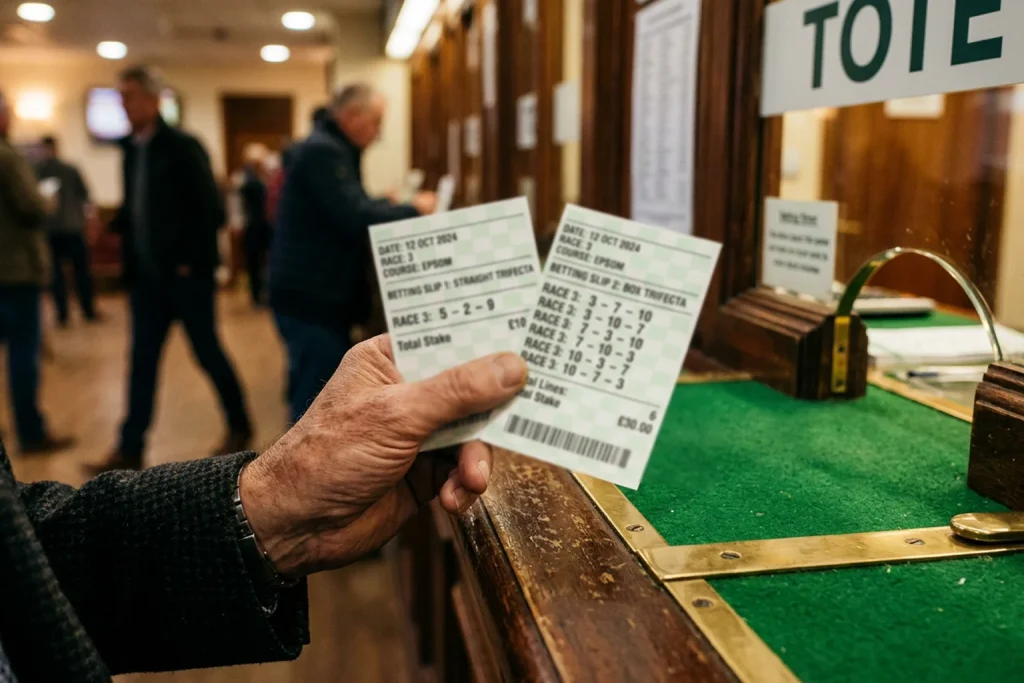
The straight versus box decision defines every trifecta bet. A straight trifecta requires your selections to finish in exact predicted order: first, second, third with no deviation. A box trifecta covers all possible finishing arrangements of your horses, accepting any order as long as they fill the three places. The choice between them involves cost, risk, and expected return calculations that depend on your confidence level and the race conditions.
The mathematics are clear. A three-horse box costs six times a straight trifecta because it covers six permutations instead of one. This cost multiplier grows with additional selections. The question is whether that multiplied cost buys proportional value. Sometimes it does; often it does not. Knowing which situation you face separates strategic betting from random expenditure.
Box betting has become the default for many punters, but defaults are not strategies. Research across 1,011 UK races shows that trifecta payouts exceed tricast in 80% of cases, but this advantage exists regardless of whether you bet straight or boxed. The box structure affects your cost and hit rate, not the underlying dividend. Understanding this distinction guides smarter structural decisions.
Both approaches have legitimate applications. Straight bets suit confident predictions where analysis strongly suggests a specific finishing order. Box bets suit competitive races where identifying the three placed horses is achievable but ordering them is essentially guesswork. Hybrid structures like key boxes occupy middle ground, offering targeted coverage at reduced cost. The skilled punter selects structure based on what the analysis actually supports.
This analysis compares straight and box approaches across cost, risk, and payout dimensions. The goal is a decision framework that matches bet structure to race analysis rather than applying uniform approaches regardless of context.
Straight Trifecta vs Box Trifecta — More on this topic at trifecta box bet.
Cost Comparison
The mathematics of trifecta box cost derive from the permutation formula n × (n-1) × (n-2), where n equals the number of horses selected. A straight trifecta always costs one unit stake regardless of how many horses are in your selection set, because you specify exact positions. A box covers all permutations, multiplying cost accordingly.
Three-Horse Comparison
With three horses, the contrast is stark. A straight trifecta on horses A, B, and C to finish first, second, and third costs £1 at unit stake. A box on the same three horses covers all six possible orderings: ABC, ACB, BAC, BCA, CAB, CBA. Cost: £6 at the same unit stake. Boxing multiplies your outlay by six.
This sixfold difference establishes the baseline for evaluating boxing value. If your straight bet has a one-in-six chance of correctly ordering the horses given they fill the places, boxing breaks even on expected value. If you believe your ordering prediction has better than one-in-six accuracy, straight betting offers better returns. If you have no basis for predicting order, boxing provides fair insurance.
Four-Horse Comparison
Adding a fourth horse transforms the cost structure. A straight trifecta still costs one unit because you specify three positions exactly. A four-horse box covers 4 × 3 × 2 = 24 combinations. Cost: £24 at unit stake versus £1 for straight. The multiplier has grown from 6x to 24x.
This escalation reflects the combinatorial nature of exotic betting. Each additional horse exponentially increases permutations while a straight bet remains fixed. A punter comparing straight versus box at four horses must justify twenty-four times the outlay through improved hit rate or equivalent expected value.
Five and Six-Horse Comparisons
At five horses, straight remains £1 while box reaches 5 × 4 × 3 = 60 combinations, costing £60. The multiplier is now 60x. At six horses, straight stays £1 while box hits 6 × 5 × 4 = 120 combinations, costing £120. The cost differential has grown to triple digits.
| Horses Selected | Straight Cost | Box Cost | Multiplier |
|---|---|---|---|
| 3 | £1 | £6 | 6x |
| 4 | £1 | £24 | 24x |
| 5 | £1 | £60 | 60x |
| 6 | £1 | £120 | 120x |
What the Multiplier Means
The multiplier quantifies the break-even point for boxing decisions. A 6x multiplier means boxing is neutral if your correct-order probability is one-sixth. A 24x multiplier means boxing is neutral if your correct-order probability is one-twenty-fourth. Beyond these thresholds, boxing costs more than the insurance is worth.
Few punters can accurately predict finishing order among genuinely competitive horses better than random chance. In an open handicap with four evenly-matched contenders, predicting which finishes first versus second versus third is essentially guesswork. The 24x box multiplier provides insurance that exceeds its cost in such situations. The cost is justified by the uncertainty.
Conversely, races with clear pace dynamics or form separation may allow better-than-random ordering prediction. If analysis suggests horse A will lead throughout while B and C fight for the places, straight betting captures that insight at minimal cost. Boxing wastes money on permutations where A does not win, which contradicts the analysis.
Risk Profile Analysis
Straight and boxed trifectas present fundamentally different risk profiles beyond their cost structures. Understanding these profiles helps match bet type to individual risk tolerance and betting objectives.
Straight Trifecta Risk Profile
A straight trifecta is a high-precision, high-risk proposition. You need three things to go right simultaneously: correct identification of the three placed horses, and correct sequencing of those horses in exact order. Miss any element and you lose entirely. No partial credit exists for getting two positions correct or identifying the horses in wrong order.
The probability of a successful straight trifecta in a competitive handicap is low. Even strong form analysis might correctly identify the first three finishers only 5-15% of the time. Among those successful identifications, predicting exact order adds another layer of difficulty. Combined probability of success for a well-analysed straight trifecta might be 1-3%. Most straight bets lose.
However, returns when straight bets win are undiluted. The full dividend applies to a single combination. A £1 winning straight bet on a £500 dividend returns £500. The low hit rate is offset by concentrated returns, but only if you actually hit. The majority of straight trifecta punters experience extended losing runs punctuated by occasional large wins.
Box Trifecta Risk Profile
A box trifecta trades precision for coverage. You need to identify the three placed horses but not their order. This removes one layer of difficulty, improving hit rate at the cost of diluted returns per successful combination.
Data suggests trifecta succeeds more often than tricast in 80% of races, demonstrating the value of pool betting. This advantage applies regardless of whether you bet straight or boxed, but boxing increases your chance of capturing any given race’s dividend by covering all orderings of your selections.
The risk reduction is real but comes at substantial cost. A four-horse box at £1 per combination costs £24. If the winning combination pays £500, your return is £500 on a £24 investment, not £500 on £1. The effective dividend relative to stake drops from 500x to approximately 21x. You win more often but win proportionally less when you do.
Expected Value Comparison
Expected value calculations clarify the trade-off. Consider a four-horse box with 10% probability of identifying the correct three horses. If ordering among those horses is random, each of the 24 permutations has equal probability. Expected dividend averages £400.
Straight bet expected value: 0.10 × (1/24) × £400 = £1.67 on a £1 stake. Positive expected value.
Box bet expected value: 0.10 × £400 = £40 on a £24 stake. Same expected value in absolute terms (£40/£24 ≈ 1.67x), but achieved through different hit rate and return profile.
The expected values are identical when ordering is random. The choice depends on variance tolerance, not expected return. Punters who prefer frequent small wins over rare large wins should box. Punters comfortable with extended losing runs in pursuit of bigger scores should play straight.
Payout Scenarios
Real examples illuminate how straight versus box decisions affect actual returns. These scenarios draw on UK racing dividend data to demonstrate practical outcomes.
Scenario One: Longshot Trifecta
The 2024 Royal Ascot Coventry Stakes produced a record-breaking trifecta dividend of £122,667.10 to a £1 stake, as recorded by Sandracer. An 80/1 winner led home 40/1 and 50/1 horses. Consider a punter who identified all three longshots but was uncertain about order.
Straight bet outcome: If the punter correctly predicted the exact order, a £1 bet returned £122,667.10. If wrong on order but right on horses, nothing. The precision required was immense, and failure meant losing entirely despite identifying all three horses.
Box bet outcome: A three-horse box cost £6 and guaranteed capturing the dividend if those three horses filled the places in any order. Return: £122,667.10 on £6 outlay, profit of £122,661.10. The punter sacrificed £5 of potential profit (the difference between £6 and £1 stake) in exchange for certainty of collection given correct horse identification.
In this extreme scenario, the box cost virtually nothing relative to the dividend. The £5 insurance cost bought certainty worth over £122,000.
Scenario Two: Mixed-Price Trifecta
A typical competitive handicap might produce a £350 trifecta dividend when a 10/1 winner beats 8/1 and 14/1 horses. A punter boxing four horses including these three invested £24.
Straight bet outcome: Correct order prediction returns £350 on £1 stake, profit £349. Wrong order returns nothing.
Box bet outcome: Any order of the three winning horses among the four boxed returns £350 on £24 stake, profit £326. The box sacrificed £23 of potential profit for elimination of ordering risk.
Here the trade-off is more substantial. The £23 insurance cost represents 7% of the potential dividend. Whether this cost is justified depends on the punter’s confidence in predicting order. With four evenly-matched horses, random ordering probability is one-in-twenty-four; the box provides value. With clear form separation suggesting likely order, the straight bet preserves that £23.
Scenario Three: Favourite-Dominated Trifecta
A race where the 2/1 favourite wins with 5/1 and 7/1 filling places might produce a £95 trifecta dividend. A punter boxing four horses including these three at £24 stake faces different mathematics.
Straight bet outcome: Correct order returns £95 on £1, profit £94.
Box bet outcome: Any order returns £95 on £24, profit £71.
The box has consumed nearly a quarter of the dividend. At this dividend level, boxing becomes expensive relative to potential return. A punter who correctly identified the favourite as winner and was reasonably confident about the place horses’ relative order would do better straight betting several combinations than boxing all permutations.
Breakeven Analysis
The scenarios suggest a dividend threshold below which boxing becomes questionable. When box cost exceeds 10-15% of expected dividend, the insurance is expensive. For a £24 four-horse box, dividends below £160-240 represent potentially poor value for boxing. Races likely to produce such modest dividends, those dominated by short-priced horses, may warrant straight betting or no trifecta activity at all.
Decision Framework
A systematic approach to the straight versus box decision considers several factors before each bet. This framework structures the thought process rather than providing rigid rules.
Factor One: Ordering Confidence
Ask honestly: can I predict the finishing order among my selections better than random chance? If three horses seem genuinely interchangeable, ordering confidence is low and boxing provides appropriate insurance. If one horse appears clearly superior and another clearly weakest among your selections, ordering confidence is higher and straight betting captures that insight.
Ordering confidence comes from pace analysis, recent form comparisons, trainer patterns, and race dynamics. A front-runner facing no pace pressure will likely lead throughout. A closer who needs a strong pace may rely on other runners setting up the race. These dynamics inform sequencing in ways that general form analysis does not.
Factor Two: Expected Dividend Level
Estimate the likely dividend if your selections fill the places. Boxes become progressively worse value as dividends decrease. A £6 three-horse box on a potential £2,000 dividend sacrifices 0.3% to insurance. The same box on a potential £60 dividend sacrifices 10%. Target boxing activity toward races where dividend potential justifies the insurance cost.
Dividend estimation improves with experience. Competitive handicaps with longshot possibilities produce larger dividends. Races with short-priced horses in contention compress dividends. The price structure of your selections provides the clearest guide: three double-digit shots suggest meaningful dividends; three single-digit shots suggest modest returns.
Factor Three: Number of Selections
The boxing decision becomes more complex with more horses. A three-horse box at 6x multiplier is manageable. A six-horse box at 120x multiplier represents a fundamentally different proposition. As selections increase, consider whether all are genuinely necessary or whether some are insurance horses unlikely to place.
Larger boxes may warrant restructuring rather than simple straight-versus-box comparison. A six-horse selection might become a four-horse box with two backup horses in cheaper structures. The goal is matching coverage to conviction rather than blindly boxing everything.
Factor Four: Bankroll Context
Available bankroll affects optimal strategy. A punter with substantial resources can absorb the variance of straight betting, enduring losing runs until large wins arrive. A punter with limited resources may need the steadier returns of box betting to maintain activity. Neither approach is inherently superior; they suit different circumstances.
Similarly, occasional recreational punters differ from regular players. A once-monthly flutter at a major meeting might warrant boxing for guaranteed collection if selections prove correct. A daily player building long-term records can tolerate individual losses better because volume smooths variance.
The Decision Tree
Synthesising these factors produces a practical decision sequence. First, assess ordering confidence. High confidence points toward straight or selective combinations. Low confidence points toward boxing. Second, estimate dividend level. High dividends justify boxing costs; low dividends question boxing value. Third, consider selection count. Smaller groups box efficiently; larger groups may need restructuring. Fourth, apply bankroll context. Match bet structure to available resources and betting frequency.
This framework does not guarantee correct decisions but ensures deliberate ones. The punter who works through these factors before every bet develops intuition that eventually operates automatically. Deliberate practice creates skilled judgement.
Hybrid Approaches
The straight versus box binary oversimplifies available options. Hybrid structures combine elements of both approaches, providing targeted coverage that matches specific analytical conclusions. These intermediate structures often offer better value than either pure approach.
Key Box Structures
A key box anchors one horse in a specific position while boxing others around it. If you believe Horse A will definitely win but cannot separate B, C, and D for the places, a key box with A first and B, C, D rotating through second and third covers six combinations rather than twenty-four for a full four-horse box.
The cost saving is substantial: six combinations versus twenty-four represents 75% reduction. This saving comes from expressed conviction. If A wins and your other horses fill the places, you collect. If A finishes second or third, you lose despite identifying all the placed horses. The structure rewards accurate analysis and punishes incorrect conviction equally.
Multi-position keys extend flexibility. Keying A to first or second while others fill remaining positions covers more outcomes than single-position keying while maintaining cost advantage over full boxing. The mathematics require careful calculation but produce tailored coverage unavailable from simple straight or box approaches.
Part Wheel Structures
Part wheels fix multiple positions while allowing rotation in one. If analysis suggests A will win, B will finish second, and either C, D, or E will complete the frame, a part wheel covers three combinations: A-B-C, A-B-D, A-B-E. Cost: £3 at unit stake versus £60 for a full five-horse box.
This precision requires correspondingly precise analysis. Getting A and B correct in sequence while missing the third horse still loses. But when conviction supports such precision, the cost savings enable either larger stakes or broader activity across multiple races. The punter who identifies one strong part-wheel opportunity might deploy savings toward additional positions elsewhere.
Backup Combination Strategy
Some punters combine a preferred straight bet with backup boxes covering alternative orderings. A punter confident that A-B-C will finish in that order might bet £5 straight on A-B-C plus £1 boxes on combinations involving those horses in different orders.
This approach weights expected returns toward the predicted outcome while maintaining coverage for variations. If A-B-C wins, the £5 straight dominates. If A-C-B wins, the backup box provides consolation. The blended structure reflects nuanced confidence levels rather than binary conviction.
When Hybrids Excel
Hybrid approaches work best when analysis produces graduated confidence. Races where one horse stands out but others are closely matched suit key boxes. Races where two horses dominate but the third is uncertain suit part wheels. Races where ordering among equals is pure guesswork suit full boxes.
The worst application of hybrids is arbitrary structure selection. Keying a horse to win when you have no genuine confidence in that outcome adds risk without analytical foundation. Honest assessment of what you actually know should drive structure choice. If you cannot articulate why A will beat B, you do not have a keying opinion; you have a boxing situation.
Practical Application
Building facility with hybrid structures requires practice. Start by analysing races without betting, determining what structure best fits your conclusions, and tracking whether subsequent results would have validated those structures. Over time, pattern recognition improves. You learn which race types produce keying opportunities and which demand fuller coverage.
See also Articles.
The goal is flexibility. Rigid adherence to straight betting leaves value on the table when uncertainty is genuine. Rigid boxing wastes money when analysis supports precision. The skilled exotic bettor moves fluidly between structures, matching bet construction to situational requirements. This adaptability separates profitable long-term players from those who occasionally get lucky.
Record keeping proves essential for evaluating structural decisions over time. Track not only wins and losses but also the structure used and why. After a hundred recorded decisions, patterns emerge. Perhaps your keying decisions underperform while your full boxes excel. Perhaps certain race types consistently suit one approach. The data reveals what intuition cannot.
The broader industry context affects structural choices. According to the HBLB Annual Report 2024-25, levy income reached £108.9m in 2024/25, the highest since the 2017 reforms, even as betting turnover per race fell 8% compared to the previous year. This paradox of rising levy income alongside declining turnover reflects changing bookmaker margins rather than growing activity. For punters choosing between straight and boxed approaches, smaller pools may compress dividends, making cost control through straight betting or precise hybrid structures increasingly important.
Alan Delmonte, Chief Executive of the Horserace Betting Levy Board, has noted: “The last two months, February and March 2025, saw bookmakers’ gross profits well above recent norms, with March’s outturn reflecting particularly bookmaker-friendly results at the Cheltenham Festival.” This variability in bookmaker margins underscores why structural discipline matters. When results favour bookmakers, pool dividends may disappoint even on correctly selected combinations. Controlling costs through appropriate structure selection provides insulation against margin-driven dividend compression.
The straight versus box question has no universal answer because every race presents different information. The framework and hybrid options described here provide tools for making intelligent decisions. Applied consistently, they transform exotic betting from guesswork into structured analysis with measurable outcomes. Know your bet before you place it, and let the analysis guide the structure.
