
Computer Tricast Dividend Explained: How UK Payouts Work
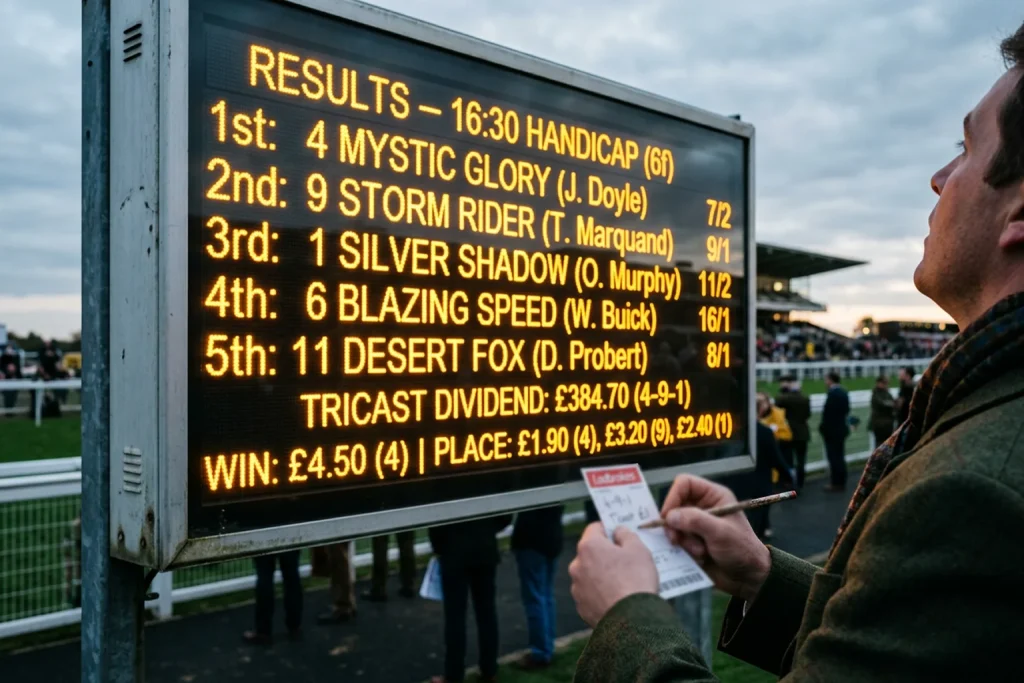
What Is a Computer Tricast?
The Computer Tricast represents British bookmaking’s answer to a mathematical challenge: how to offer tricast betting on races without a Tote pool. Rather than dividends determined by pool wagering, Computer Tricast payouts derive from a formula based on starting prices. The system ensures tricasts remain available on eligible races regardless of whether sufficient pool liquidity exists.
This distinction matters because it affects what you can expect to receive. A Tote trifecta dividend reflects actual money wagered and distributed. A Computer Tricast dividend reflects a mathematical calculation that bookmakers have agreed to honour. Both produce payouts for selecting the first three finishers in correct order, but the mechanism behind each differs fundamentally.
The system emerged from practical necessity. Many races, particularly those at smaller meetings or less popular time slots, fail to generate sufficient trifecta pool interest to produce meaningful dividends. Without Computer Tricast, bookmakers would either decline tricast bets on these races or offer arbitrarily determined payouts. The formula approach provides consistency while maintaining the exotic betting option.
Computer Tricast availability depends on race conditions. The bet applies to handicap races with eight or more declared runners, provided at least six actually start. Non-handicap races, regardless of field size, do not qualify. This restriction reflects the formula’s design: it works best when the weight-for-age variables of handicapping create genuine competitive depth.
Understanding how Computer Tricast dividends are calculated helps you evaluate whether the offered returns justify your stake. The system has predictable characteristics once you grasp its formula factors, and these characteristics influence when Computer Tricast betting offers genuine value versus when pool-based alternatives might serve you better.
Formula Factors
Computer Tricast dividends calculate using starting prices of the first three finishers, adjusted by several factors. The core calculation multiplies the SP odds in a structured way, then applies modifiers that account for race characteristics.
The base calculation takes the win odds of each placed horse. A 10/1 winner with a 5/1 second and 8/1 third produces a higher base figure than a 2/1 winner with similar-priced place finishers. This intuitive relationship means that Computer Tricast dividends generally correlate with the cumulative unlikelihood of the result.
Favourite position modifies the payout. When the favourite wins, the dividend compresses. When the favourite finishes second or third, the calculation adjusts upward but less than if the favourite were absent entirely. When the favourite finishes outside the first three, the dividend typically reaches its highest potential for that combination of placed horses. Research from Geegeez analysing 1,011 UK handicap races found that Computer Tricast dividends averaged 26% lower than equivalent Tote trifecta payouts, though individual races vary considerably.
Field size plays a role in the formula. Larger fields produce higher base dividends because the mathematical probability of selecting three horses from a bigger pool is lower. This explains why Computer Tricasts are only available on handicap races with eight or more runners, per Bet365 rules. Smaller fields would produce dividends too low to attract meaningful interest.
Draw position receives consideration in sprint races where stalls influence finishing positions. The exact weighting varies between the formula versions different bookmakers employ, but the general principle remains: unlikely combinations from a draw perspective receive slight upward adjustment.
The formula itself is not published in full detail by bookmakers, which creates some opacity. What punters can observe is that Computer Tricast dividends behave predictably relative to the SPs involved. You will not find wild divergences from expected values in the way that thin Tote pools occasionally produce.
How Dividends Are Declared
Computer Tricast dividends are calculated and declared shortly after the race result is confirmed. The process involves the Racing Post and Press Association, which compute the dividend using the agreed formula and distribute it to all participating bookmakers.
This centralised calculation ensures consistency. Unlike Tote dividends where each pool produces its own figure based on money invested, Computer Tricast dividends are identical across all bookmakers offering the bet. Whether you placed your tricast with Bet365, William Hill, or Paddy Power, the declared dividend applies equally.
Timing typically sees dividends announced within fifteen minutes of the weigh-in. For punters checking results, the Computer Tricast dividend appears alongside SP returns and Tote dividends in race result summaries. Bookmaker websites and racing data services publish these figures as standard race data.
Declaration delays can occur when stewards’ enquiries affect the result. If the placings change after an enquiry, the Computer Tricast dividend is recalculated based on the amended finishing order. This process can take longer than standard declaration, occasionally causing confusion for punters expecting immediate confirmation.
In cases involving dead heats, the dividend splits according to dead heat rules, with punters receiving a proportional payout based on the number of horses involved in the tie. The calculation maintains the same formula structure but divides the result appropriately.
Non-runner situations require specific handling. When a horse in your tricast combination is withdrawn, the bet does not automatically void. Instead, it converts to a straight forecast on the remaining two selections, calculated at Computer Forecast rather than tricast rates. This conversion typically results in a smaller payout than the tricast would have delivered, assuming your two remaining selections fill the first two places.
Computer vs Pool Dividends
The relationship between Computer Tricast and Tote trifecta dividends follows observable patterns. In approximately 80% of races where both are available, the Tote trifecta pays more. The average premium runs around 26%, though this figure masks considerable variation.
When trifecta does outperform tricast, the margin averages 59% higher. When tricast beats trifecta, which happens in roughly 20% of races, the margin averages 52% higher. These asymmetric figures suggest that trifecta outperformance tends to be more substantial when it occurs.
Field size influences which bet type offers better value. In races with 12 to 14 runners, the trifecta advantage reaches 25% or greater on average. Smaller fields see the gap narrow. Very large fields, such as the Grand National with forty runners, can see either dividend lead depending on how public money distributes across combinations.
Consider a concrete example. The 2024 Coventry Stakes at Royal Ascot produced a Computer Tricast dividend of £83,273.26. The Tote trifecta for the same result paid £122,667.10, according to Sandracer. That 47% premium for the trifecta reflected the pool dynamics of a high-profile race where public money concentrated on combinations that did not land.
The practical implication: when both options are available, trifecta typically offers better expected value. However, Computer Tricast provides certainty of availability. Not every race generates sufficient trifecta pool liquidity, whereas Computer Tricast applies systematically to eligible handicaps.
Rule 4 deductions add another consideration. When late withdrawals trigger Rule 4, fixed-price tricasts get recalculated using the Computer Tricast dividend instead of the originally agreed terms. This protects bookmakers from exposure on bets placed before non-runners were announced, but it also means punters cannot lock in a favourable early price on tricast combinations the way they might on win bets.
Seasonal patterns affect the comparison. Summer flat racing at major courses tends to produce larger trifecta pools, widening the gap in favour of pool betting. Winter jump racing at smaller tracks often sees thinner pools where the Computer Tricast represents the more practical option despite its typically lower returns.
Demystifying the dividend calculation helps you make informed choices. Neither option is universally superior. Match your bet type to the race characteristics and available pool sizes for optimal results.