
Exacta vs Trifecta: Which Exotic Bet Offers Better Value?
Two Horses or Three
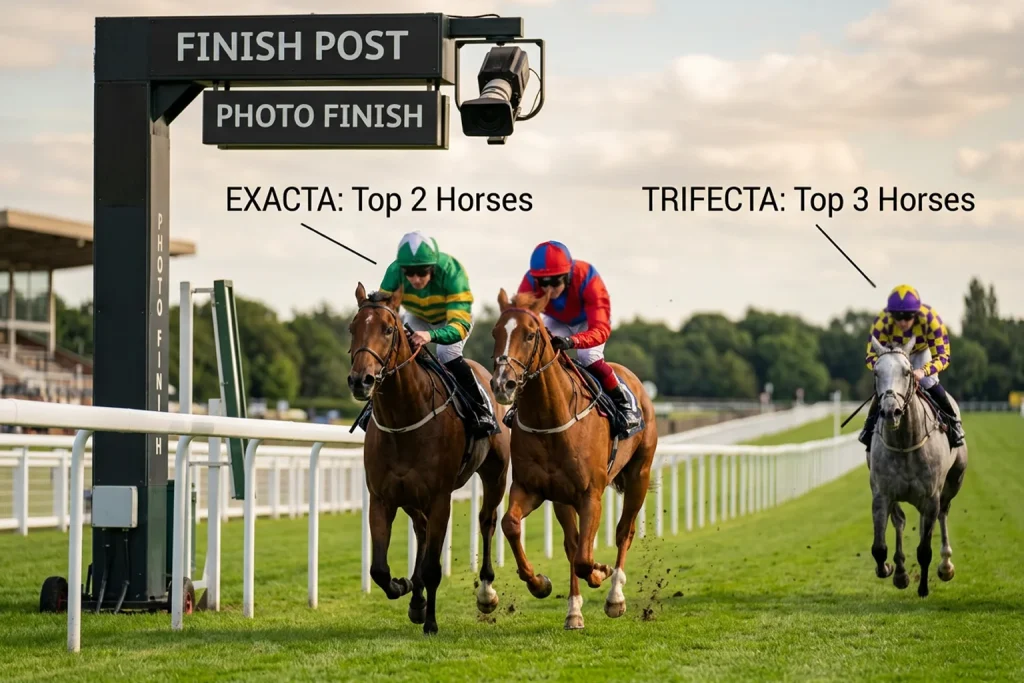
The choice between exacta and trifecta betting comes down to complexity versus reward. An exacta, called a forecast in UK terminology, requires predicting the first two finishers in correct order. A trifecta, known as a tricast, extends this to the first three. The additional horse dramatically increases difficulty while also expanding potential returns.
Both bets belong to the exotic category, distinguished from simple win or place wagers by their requirement for multiple correct predictions. The exacta vs trifecta decision represents a fundamental strategic choice about where to position yourself on the risk-reward spectrum.
Neither bet is inherently superior. Each serves different purposes and suits different situations. Understanding when each offers genuine value requires examining the mathematics, historical payout patterns, and practical scenarios where one structure outperforms the other.
Two vs three is not just about numbers. It reflects your confidence level, your risk tolerance, and your assessment of how predictable a particular race might be.
UK punters have access to both bet types across major bookmakers, though terminology differs from American usage. The forecast covers first and second, while the tricast adds third. Boxing either bet type covers all possible orderings among your selections, multiplying both coverage and cost proportionally.
Difficulty Comparison
The mathematical difficulty gap between exacta and trifecta is substantial. In a twelve-horse race, the number of possible exacta combinations equals 12 × 11 = 132. The number of possible trifecta combinations equals 12 × 11 × 10 = 1,320. Adding the third horse multiplies your combinations by a factor of ten.
This tenfold increase in possibilities directly affects win probability. A single straight exacta in a twelve-horse race gives you roughly 0.76% chance of hitting if all horses were equally likely. A single straight trifecta offers approximately 0.076% chance under the same assumption. Your probability drops by a full order of magnitude.
Boxing partially addresses this gap but at significant cost. A three-horse exacta box covers 6 combinations, improving your win probability. A three-horse trifecta box also covers 6 combinations but requires all three selections to fill the first three places, not just the first two. The trifecta box demands more from your horses.
Form analysis difficulty increases with each required prediction. Identifying a likely winner represents one analytical challenge. Identifying the second horse accurately requires filtering the remaining field with similar precision. Identifying the third horse compounds this further, often depending on small margins between evenly matched runners.
Research from Geegeez covering 1,011 UK handicap races found that trifecta dividends exceeded tricast equivalents in 80% of races, suggesting that the market systematically underprices trifecta outcomes. This finding indicates that despite the increased difficulty, trifectas may offer disproportionate reward relative to their complexity.
The difficulty increase from exacta to trifecta is not linear. The third horse prediction often proves hardest because the horses contesting third place tend to be more evenly matched than those contesting first or second. Close finishes for third are common, adding genuine uncertainty that even strong form analysis cannot fully resolve.
Cost considerations amplify difficulty differences. A four-horse exacta box costs 12 combinations. A four-horse trifecta box costs 24 combinations, double the exacta. This cost premium reflects the additional coverage required but also increases your exposure when selections prove incorrect.
Payout Expectations
Trifecta dividends typically exceed exacta dividends by substantial margins, reflecting the increased difficulty. The ratio varies considerably depending on the starting prices of the placed horses and the pool distributions involved.
In races where all three placed horses trade at similar middle-market prices, trifectas often pay three to five times the equivalent exacta. When long shots fill the third position, this ratio can expand to ten times or more. The third horse acts as a multiplier on the base exacta value.
The Geegeez research found that when trifectas outperformed tricasts, they did so by an average margin of 59%. When tricasts outperformed trifectas, the margin averaged 52%. This asymmetry suggests that trifecta outperformance tends to be more dramatic than tricast outperformance.
Exacta dividends offer more predictable returns within a narrower range. A successful exacta in a twelve-horse handicap might return £50 to £500 depending on the prices involved. A successful trifecta in the same race might return £200 to £5,000 or beyond. The ceiling rises substantially with the added complexity.
Pool liquidity affects dividend reliability. Exacta pools tend to be deeper than trifecta pools at most meetings because more punters feel comfortable predicting two horses than three. Deeper pools produce more stable dividends. Thin trifecta pools can produce erratic results where similar combinations in different races yield widely different returns.
The payout premium must justify the probability reduction for trifectas to offer better expected value than exactas. In most competitive handicaps, the data suggests this premium is sufficient. In smaller fields with dominant favourites, the exacta may represent better value because the third position becomes more predictable, compressing the trifecta dividend without proportionally reducing difficulty.
Major meetings produce deeper pools for both bet types. Royal Ascot, Cheltenham, and Grand National day generate sufficient volume to support reliable dividends even for unusual trifecta combinations. Midweek cards at smaller venues may favour exactas simply because their pools maintain better liquidity.
Record payouts illustrate the ceiling difference. The highest UK trifecta dividends reach six figures in exceptional circumstances, while exacta records rarely exceed five figures. This potential ceiling attracts punters seeking life-changing returns, though such outcomes remain extremely rare.
Which Bet for Which Scenario
Scenario analysis clarifies when each bet type offers superior value. The decision depends on field size, competitive depth, and your confidence in specific positions.
Choose exacta when field size falls below ten runners. Smaller fields compress trifecta dividends because the third position becomes easier to predict. The reward premium shrinks while the difficulty remains. Exactas capture value more efficiently in these conditions.
Choose trifecta in handicaps with twelve or more runners. Larger fields restore the reward premium that justifies trifecta complexity. The third position becomes genuinely uncertain, allowing the dividend to expand appropriately. The 25% or greater trifecta advantage observed in fields of twelve to fourteen runners supports this approach.
Choose exacta when you have strong conviction about the first two finishers but uncertainty about third. If your form analysis clearly identifies a winner and a likely runner-up but shows three or four horses competing for third, the exacta lets you profit from your strong opinions without gambling on the uncertain remainder.
Choose trifecta when you have identified value across multiple place positions. If your analysis suggests three or four horses are underpriced by the market for place finishes, a trifecta box captures that collective value better than an exacta can.
Richard Wayman, Director of Racing at the British Horseracing Authority, has noted that the betting environment remains challenging, with declines headed by the impact of affordability checks and their effects on betting behaviour. In this context, bet selection efficiency matters more than ever. Choosing the right structure for each race maximises returns from limited betting capital.
The decision need not be exclusive. Many punters play both structures across a card, selecting exactas for smaller fields and trifectas for competitive handicaps. This flexible approach captures value where it exists rather than forcing a single structure onto all races.