Trifecta Wheel Betting: Full and Part Wheel Strategies
What Is Trifecta Wheel Betting?
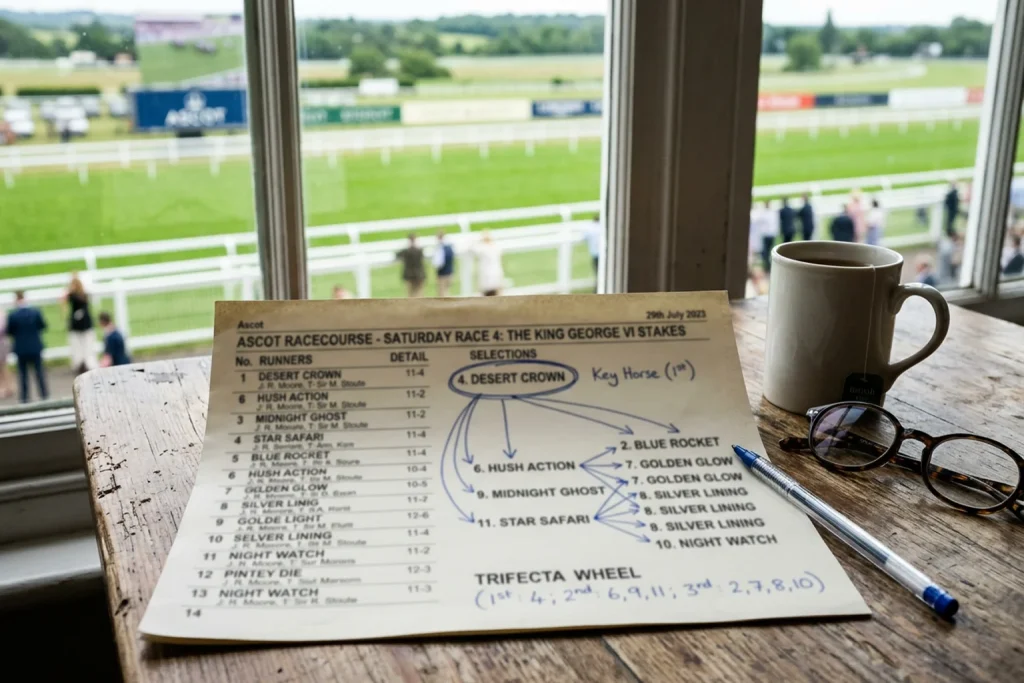
Trifecta wheel betting gives you structured coverage without the full cost of boxing. Where a box covers every possible arrangement of your selections, a wheel locks certain horses into specific finishing positions while allowing others to rotate through the remaining spots. The result is a targeted ticket that reflects your actual opinions about the race rather than treating every outcome as equally likely.
The terminology can trip people up. In American parlance, wheels are standard. In the UK, you are more likely to hear these bets described through their construction: keying one horse to win with others filling second and third, or selecting different groups for different positions. The mechanics remain identical regardless of what you call them.
Wheel betting makes sense when your confidence varies by position. Perhaps you strongly fancy one horse to win but have no real view on who finishes second or third. Or you have identified two horses that always seem to finish in the frame but rarely manage to win. A wheel lets you express these opinions efficiently. A box treats all your selections as interchangeable, which is rarely how you actually think about a race.
Two main variants exist. A full wheel includes every horse in the field for certain positions. A part wheel limits each position to selected horses only. Understanding when to deploy each structure separates efficient bettors from those who routinely overpay for coverage they do not need.
Full Wheel Explained
A full wheel places one or more horses in a fixed position and rotates every other runner in the race through the remaining positions. The classic example: you believe Frankel’s Ghost will win, but the place positions are wide open. You wheel Frankel’s Ghost to win with all other starters filling second and third.
The combination count depends on the field size. In a twelve-horse race with one horse wheeled to win, you need combinations covering every pair from the remaining eleven runners in second and third. That calculates to 11 × 10 = 110 combinations. At £1 per combination, the ticket costs £110. This is expensive, but it covers every possible placings scenario if your selection wins.
Full wheels work best in races where you have strong conviction about one position but genuine uncertainty about the others. Handicaps with large fields often create this situation. The favourite may have dominant form, but the place positions attract competitive horses at substantial prices. Total betting turnover on British racing fell 6.8% in 2024 compared to the previous year, according to the BHA Racing Report. Tighter purses make it more important to bet with precision, and full wheels offer that precision when your opinion is position-specific.
The risk, obviously, is that your wheeled selection fails to hit the designated position. If Frankel’s Ghost finishes second rather than first, your 110-combination ticket returns nothing. Full wheels demand genuine confidence in both the horse and its specific finishing position, not just general optimism about its chances.
You can also wheel to second or third. Wheeling a consistent placer to finish third with all other runners rotating through first and second can be profitable in races where an obvious favourite exists but your selection lacks the speed to beat them. The maths works identically: field size minus one, multiplied by field size minus two, gives your combination count.
Part Wheel Strategy
Part wheels refine the approach by limiting which horses can fill each position. Rather than using the entire field for second and third, you select specific groups. The cost drops dramatically, but so does your coverage.
Construction follows a logical pattern. For first position, you might select two horses you believe can win. For second, perhaps four horses with strong place credentials. For third, maybe six horses that have the ability to hit the frame when things go their way. The combination count multiplies these selections: 2 × 4 × 6 = 48 combinations. You have replaced a full wheel’s broad coverage with a targeted ticket reflecting your actual form opinions.
Part wheels reward punters who do their homework. If your form analysis identifies genuine contenders, a part wheel captures value without paying for combinations involving horses you do not rate. If your analysis is flawed, you pay a price: the winning combination might include a horse you excluded from a position where it ultimately finished.
Consider a practical scenario. The 3.45 at Newmarket features a twelve-horse handicap. You rate two horses for the win: the well-handicapped returning favourite and an unexposed three-year-old. For second, you identify four consistent performers. For third, you include those four plus two outsiders with place potential. Your part wheel: 2 × 4 × 6 = 48 combinations at £1 each, totalling £48.
Compare this to a full six-horse box at 120 combinations, or a full wheel at 110+ combinations. The part wheel saves money but introduces risk. If the winner comes from your second or third position groups rather than your win selections, you lose. If a horse you excluded finishes in a position you did not assign them to, you lose. Part wheeling is a precision tool, not a safety net.
The skill lies in allocation. Put too many horses in each position and costs escalate toward full box territory. Put too few and you miss live combinations. Experienced trifecta punters often build part wheels after watching market movements on the day, adding horses that attract late support while excluding those drifting in the betting.
Wheel vs Box Comparison
Wheels and boxes serve different purposes, and understanding when each excels matters for your long-term results.
A box treats all your selections as equals. Any finishing order among your chosen horses wins. This suits situations where you have identified three to six contenders but have no strong opinion about their relative finishing positions. The cost is straightforward: n × (n-1) × (n-2) combinations, where n is your number of selections. A five-horse box costs 60 combinations. Every horse can finish first, second, or third.
A wheel imposes structure. You assign horses to positions based on your form analysis. This suits situations where your opinions are position-specific. Maybe you are confident about who will win but unsure about the places. Or you have identified consistent placers who lack the pace to win. Wheels capture these opinions without forcing you to pay for combinations you do not believe in.
Cost comparison depends on construction. A full wheel with one horse to win and ten others for second and third costs 90 combinations. That exceeds many box structures. But a tight part wheel with two horses for win, three for second, and four for third costs only 24 combinations, cheaper than a four-horse box.
The key difference is risk distribution. Boxes spread risk across all combinations equally. If any three of your selections fill the first three positions in any order, you win. Wheels concentrate risk on your position assignments being correct. If your analysis is sound, wheels offer better value. If your analysis is flawed, boxes provide more forgiving coverage. Research from Geegeez found that trifecta payouts exceed tricast dividends in 80% of races, regardless of construction method—the structural edge applies whether you wheel or box.
Spin the wheel strategically. Reserve wheels for races where your opinion is clearly structured by position. Use boxes when your view is simpler: these horses will fill the places, but damned if you know which order they will finish.