
How to Calculate Trifecta Box Cost: Formula and Examples
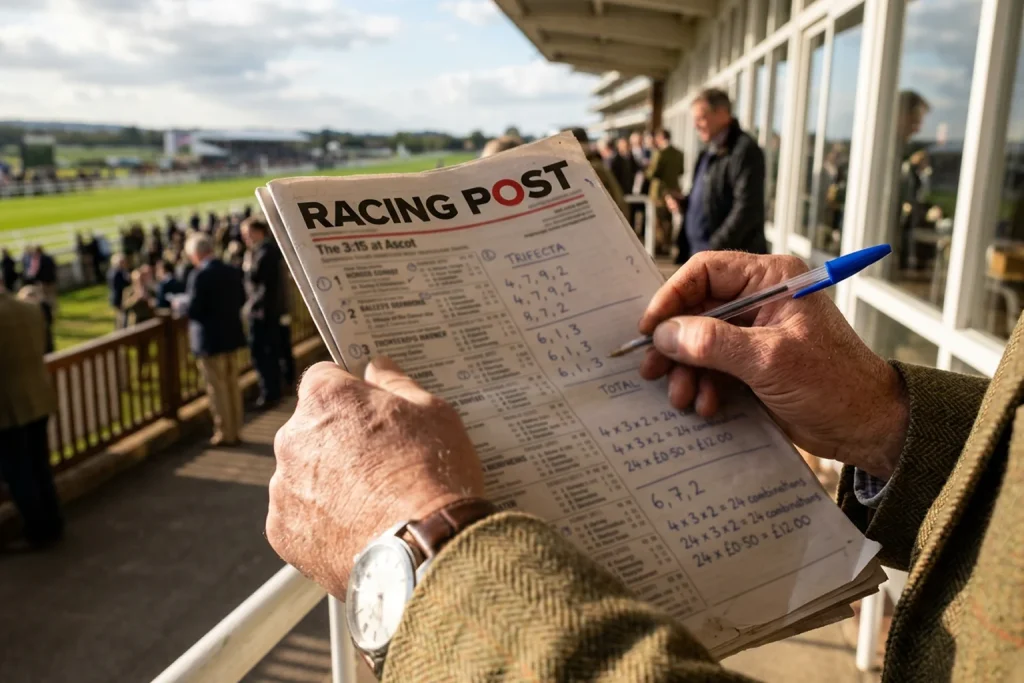
Every punter who has ever considered a trifecta box bet faces the same question: how much will this actually cost me? The answer lies in a simple formula that governs every tricast combination on British racecourses. Understanding trifecta box cost calculation separates informed betting from blind speculation.
The mathematics are straightforward once you grasp the underlying logic. A trifecta box covers all possible finishing orders for your selected horses in the first three places. Select three horses and you need six combinations. Add a fourth horse and that number jumps to twenty-four. The escalation follows a predictable pattern that this guide will make intuitive.
What makes cost calculation essential rather than academic is the relationship between outlay and potential return. A poorly structured box bet can consume your stake before the horses even load into the stalls. Conversely, understanding the mathematics allows you to calibrate your ticket to match both your conviction and your bankroll. The formula n × (n-1) × (n-2), where n equals your number of selections, is your tool for making that calibration precise.
British punters often use the terms tricast and trifecta interchangeably, though subtle distinctions exist. Tricast typically refers to fixed-odds or computer dividend bets offered by traditional bookmakers, while trifecta describes Tote pool betting where returns depend on pool size and the number of winning tickets. For cost calculation purposes, the mathematics remain identical. Whether you place your bet through the Tote window or a high street bookmaker, selecting four horses still requires covering twenty-four permutations.
This guide walks through the cost formula from first principles, provides reference tables for quick lookup, and demonstrates calculation with worked examples at various stake levels. Whether you are boxing three horses for a modest flutter or constructing a more ambitious six-horse combination, the numbers work the same way.
The Trifecta Box Formula
The cost of any trifecta box bet derives from a permutation formula: n × (n-1) × (n-2). This is not arbitrary mathematical notation but a precise description of what happens when horses cross the finish line. To win a trifecta, you need to identify three horses finishing first, second, and third. A box bet covers every possible arrangement of your selections in those positions.
Consider why the formula takes this form. For the first-place position, any of your n selections could win. Once a horse finishes first, the remaining (n-1) horses compete for second place. After first and second are determined, (n-2) horses remain as candidates for third. Multiplying these possibilities together gives the total number of permutations your box bet must cover.
Three-Horse Box
The minimum trifecta box involves three horses. Applying the formula: 3 × 2 × 1 = 6 combinations. These six permutations represent every possible finishing order. Horse A could finish first with B second and C third. Or C first, A second, B third. And so on through all six arrangements. At a £1 unit stake, this three-horse box costs £6.
Four-Horse Box
Adding just one more selection transforms the mathematics. A four-horse box requires: 4 × 3 × 2 = 24 combinations. That single extra horse quadruples your outlay compared to the three-horse box. The progression is non-linear, which catches many punters off guard. At a £1 unit stake, four horses cost £24.
Five-Horse Box
The escalation continues: 5 × 4 × 3 = 60 combinations. A five-horse box at £1 per combination costs £60. You are now betting on sixty distinct finishing orders, only one of which can occur. The cost has grown tenfold from the basic three-horse structure.
Six-Horse Box
At six horses, the calculation yields: 6 × 5 × 4 = 120 combinations. A £1 unit stake means a £120 total outlay. Most recreational punters pause at this level. The mathematics demand either substantial stakes or careful selection to justify the investment.
Seven and Eight-Horse Boxes
Extending beyond six selections produces striking figures. Seven horses generate 7 × 6 × 5 = 210 combinations. Eight horses require 8 × 7 × 6 = 336 combinations. At standard £1 stakes, these boxes cost £210 and £336 respectively. Such expansive coverage occasionally suits major festival handicaps where form is murky and longshots frequently fill the places, but the maths quickly become prohibitive for regular betting.
The Tote takes a 25% commission from UK trifecta pools, as documented by Geegeez in their analysis of pool betting returns. This takeout affects your expected value regardless of how many combinations you box. Understanding both your ticket cost and the pool deduction helps set realistic expectations for what a winning bet might return.
Why Permutations Matter
The distinction between permutations and combinations is crucial. A combination treats ABC and CBA as identical groups. A permutation treats them as distinct arrangements. Trifecta betting deals in permutations because order matters absolutely. First, second, and third are not interchangeable positions. The horse that wins by a nose collects a different dividend than the horse beaten by that nose. Your box bet must account for every possible ordering, hence the permutation formula.
Some punters confuse trifecta box costs with the number of possible trifecta outcomes in a race. These are entirely different calculations. The number of possible trifecta outcomes depends on the field size and represents all permutations of all runners. Your box bet covers only the permutations of your selected horses. In a twelve-horse race, there are 1,320 possible trifecta outcomes (12 × 11 × 10), but your four-horse box covers just 24 of them.
Combination Reference Table
Applying the formula repeatedly grows tedious. A ready reference table eliminates mental arithmetic at the betting window or when constructing tickets online. The following covers the most common box sizes encountered in UK horse racing, with costs pre-calculated at standard stake levels.
| Horses Selected | Combinations | Cost at £0.50 | Cost at £1 | Cost at £2 |
|---|---|---|---|---|
| 3 | 6 | £3 | £6 | £12 |
| 4 | 24 | £12 | £24 | £48 |
| 5 | 60 | £30 | £60 | £120 |
| 6 | 120 | £60 | £120 | £240 |
| 7 | 210 | £105 | £210 | £420 |
| 8 | 336 | £168 | £336 | £672 |
The pattern reveals an important truth: each additional horse approximately doubles your previous outlay. Moving from four to five horses increases combinations from 24 to 60, a factor of 2.5. From five to six horses, combinations double from 60 to 120. This near-doubling continues throughout the range.
Extended Reference for Larger Boxes
| Horses | Formula Application | Combinations | Cost at £1 |
|---|---|---|---|
| 9 | 9 × 8 × 7 | 504 | £504 |
| 10 | 10 × 9 × 8 | 720 | £720 |
Boxes larger than eight horses venture into territory most punters find impractical. A ten-horse box at minimum 10p stakes still costs £72. The mathematics work identically, but the economics become challenging. You are essentially betting on 720 distinct outcomes from a subset of runners, requiring either exceptional value in the dividend or exceptional conviction in your selections.
Visualising the Escalation
Plot combinations against number of horses and the curve steepens dramatically. Three horses occupy the flat portion where boxing remains economical. Four and five horses occupy the middle ground where cost and coverage balance. Beyond five horses, the curve accelerates upward. This visual relationship helps explain why experienced punters often cap their boxes at five or six horses unless pursuing very large fields with correspondingly large potential dividends.
The practical ceiling depends on your betting bank and the expected dividend. Covering 120 combinations makes sense if the potential payout runs into thousands. The same 120 combinations in a race where the likely dividend is £200 represents a losing proposition before you even consider whether your horses will finish first, second, and third.
Step-by-Step Calculation Guide
Theory becomes concrete through worked examples. The following calculations demonstrate the formula in action across different box sizes and stake levels commonly used by UK punters.
Example One: Four-Horse Box at £1 Unit Stake
You have identified four horses you believe capable of filling the first three places in a handicap at Newmarket. The runners are priced at 5/1, 8/1, 12/1, and 14/1. None is a short-priced favourite, suggesting the trifecta dividend could be substantial if your selections fill the frame.
Step one: Count your selections. Four horses means n = 4.
Step two: Apply the formula. 4 × 3 × 2 = 24 combinations.
Step three: Multiply by unit stake. 24 × £1 = £24 total cost.
Your £24 investment covers all possible finishing orders of your four selections in first, second, and third places. If three of your four horses fill the trifecta positions in any order, you collect the dividend. The fourth horse could finish fourth, fifth, or last without affecting your bet.
Example Two: Five-Horse Box at £0.50 Unit Stake
A competitive sprint at York presents five viable contenders. Rather than choosing between them, you decide to box all five at a reduced unit stake to manage costs.
Step one: Five selections means n = 5.
Step two: Apply the formula. 5 × 4 × 3 = 60 combinations.
Step three: Multiply by unit stake. 60 × £0.50 = £30 total cost.
This approach covers 60 possible finishing orders while keeping total outlay at £30. The trade-off is a reduced return; your dividend will be halved compared to a £1 unit stake. If the trifecta pays £300 to a £1 stake, your £0.50 combination returns £150.
Example Three: Six-Horse Box at £1 Unit Stake
The Grand National presents unique conditions. Attrition rates are high, and form can be misleading over four miles and thirty fences. You select six horses you believe have both the stamina and jumping ability to place.
Step one: Six selections means n = 6.
Step two: Apply the formula. 6 × 5 × 4 = 120 combinations.
Step three: Multiply by unit stake. 120 × £1 = £120 total cost.
This represents serious commitment, but the context justifies it. Grand National trifecta dividends regularly reach four figures. The 2024 renewal paid £6,687.80 to a £1 stake, according to World of Horses. A successful £120 box would have returned over £6,600 in profit.
Calculating Partial Stakes
Not all bookmakers accept £0.50 minimum stakes on tricasts. Some require £1 minimums. When working with partial stakes, apply the multiplication after determining combinations:
Four horses at £0.25 unit stake: 24 combinations × £0.25 = £6 total cost.
Five horses at £0.20 unit stake: 60 combinations × £0.20 = £12 total cost.
These fractional stakes allow wider coverage on limited bankrolls, though you should verify your bookmaker accepts the minimum before placing the bet. Tote bets sometimes permit lower minimum stakes than fixed-odds tricast wagers with traditional bookmakers.
The industry context matters here. According to the HBLB’s Annual Report 2024-25, betting turnover on British racing fell 8% per race compared to the previous year, marking a continuing decline of 19% versus 2021/22. Despite this, levy income reached £108.9m in 2024/25, the fourth consecutive year of increase, reflecting improved bookmaker margins rather than growing activity. This declining turnover affects pool sizes and, consequently, dividend levels. Larger boxes in smaller pools may not generate the returns that historically justified the investment.
Quick Mental Calculation
For rapid estimation without a calculator, remember these anchor points:
Three horses equals six combinations. Four horses equals four times six, which is twenty-four. Five horses equals two and a half times twenty-four, approximately sixty. Six horses equals double sixty, which is one hundred twenty.
This mental model gets you within striking distance of the exact figure, useful when assessing whether a box bet fits your available stake before committing to precise calculation.
Cost Examples with Real Stakes
Understanding how box costs translate to practical betting scenarios helps match ambition to bankroll. The following examples reflect common betting patterns among UK punters.
The Modest Budget Approach
A punter with £10 allocated for trifecta betting faces clear constraints. The maths dictate available options:
Three-horse box at £1: £6 total, leaving £4 for additional bets or accumulation.
Four-horse box at £0.40: 24 × £0.40 = £9.60, virtually exhausting the budget on a single race.
Five-horse box at £0.15: 60 × £0.15 = £9.00, covering more combinations at minimal stake per combination.
The modest punter typically opts for the three-horse box. It preserves meaningful stake per combination while covering the minimum viable number of selections. Spreading £10 across sixty combinations at £0.15 each feels like trying to catch water with a sieve. Even a healthy dividend divided by sixty produces disappointing returns.
The Regular Punter Approach
With £25 to £50 available, options expand considerably. This stake range represents the typical commitment for punters who regularly play trifectas at weekend meetings.
Four-horse box at £1: £24, a natural fit for this bankroll level.
Five-horse box at £0.50: £30, allowing wider coverage while maintaining respectable stake per combination.
Six-horse box at £0.40: 120 × £0.40 = £48, approaching the upper limit but viable for competitive handicaps with uncertain form.
Most experienced punters in this bracket gravitate toward the four or five-horse box. The combination count stays manageable, the stake per combination remains meaningful, and the coverage provides reasonable insurance against minor misjudgements in the form analysis.
The Serious Punter Approach
Punters committing £100 or more to individual trifecta bets operate with different considerations. Cost becomes less constraining than value assessment.
Five-horse box at £1: £60, leaving room for additional wagers or alternative structures.
Six-horse box at £1: £120, full coverage of a wider selection at standard stake.
Seven-horse box at £0.50: 210 × £0.50 = £105, casting a wide net in large-field handicaps.
At this level, the discussion shifts from what can be afforded to what should be constructed. A seven-horse box at £0.50 covers more ground than a five-horse box at £1, but the reduced stake per combination limits returns. The choice depends on confidence in selections and assessment of likely dividend levels.
Research from the National Centre for Social Research indicates that the top 1% of horse racing bettors, roughly 60,000 individuals, generate 52% of industry revenue. These serious punters operate at stake levels where box cost calculation is a routine consideration rather than a limiting factor. Their success or failure depends on selection quality and value identification, not arithmetic.
Budget Allocation Across Multiple Races
Many punters prefer spreading trifecta activity across several races rather than concentrating on one. A £50 daily budget might deploy as:
Three-horse boxes in three races at £1 each: 3 × £6 = £18.
Four-horse box in one selected race at £1: £24.
Total commitment: £42, with £8 remaining for adjustment or additional plays.
This diversified approach acknowledges that even strong form analysis cannot guarantee trifecta success in any single race. Spreading exposure across multiple opportunities smooths variance, though it also dilutes focus. The punter who identifies one genuinely strong betting opportunity might do better concentrating resources there rather than scattering across several marginal situations.
Advanced Scenarios
Full boxes represent the most straightforward trifecta structure, but not always the most efficient. Alternative constructions can reduce costs while maintaining targeted coverage. These approaches require clearer conviction about relative horse merits.
Key Box Construction
A key box anchors one horse in a specific position while allowing others to rotate around it. If you believe strongly that a particular horse will win but are less certain about the minor placings, a key box with that horse in first reduces combinations substantially.
Consider a five-horse selection where you are confident Horse A will win. In a full five-horse box, you cover 60 combinations. With Horse A keyed to win, you need only cover permutations of the remaining four horses for second and third: 4 × 3 = 12 combinations. The cost drops from £60 to £12 at a £1 unit stake.
The trade-off is absolute: if Horse A finishes second or third instead of first, you lose despite correctly identifying the trifecta participants. Key boxes reward confident analysis; they punish small errors in placement prediction.
Multi-Position Key Boxes
More nuanced structures key one horse across first and second positions while others fill the remaining spots. This construction offers middle ground between full coverage and single-position keying.
With Horse A keyed to first or second and four other horses completing the frame, calculations become: Horse A first with any two of four others filling second and third (4 × 3 = 12 combinations), plus Horse A second with any of four others winning and any of three remaining in third (4 × 3 = 12 combinations). Total: 24 combinations versus 60 for a full five-horse box.
Wheel Bet Structures
Wheel bets take keying further by fixing multiple positions. A typical wheel keys one horse to win, a second to place, and rotates others through the third position only.
If you are confident Horses A and B will finish first and second respectively, with either C, D, or E completing the frame, your wheel covers just three combinations: A-B-C, A-B-D, and A-B-E. At £1 per combination, total cost is £3 compared to £60 for boxing all five horses.
The precision required for successful wheeling is demanding. Professional punters use wheels in situations where form analysis produces clear separation between runners. Recreational punters often find full boxes more forgiving of analytical imprecision.
Cost-Reduction Strategies
Beyond alternative structures, practical strategies reduce effective cost without changing bet architecture:
Smaller unit stakes stretch coverage further but dilute returns. A £0.50 stake on 60 combinations costs the same as a £1 stake on 30 combinations but provides double the coverage at half the per-combination return.
Selective racing targets events where trifecta value is historically higher. Competitive handicaps with double-digit fields tend to produce larger dividends than conditions races dominated by a short-priced favourite. Concentrating activity on value opportunities improves overall return even if win rate remains constant.
Pool versus fixed-odds assessment matters. The Tote trifecta pool may offer better value in some races, while bookmaker computer tricasts provide superior returns in others. Checking both before committing reduces effective cost by securing better terms when available.
Industry Context for Advanced Play
The viability of complex trifecta strategies depends partly on broader market conditions. Richard Wayman, Director of Racing at the British Horseracing Authority, has noted the challenging betting environment: “I’ve no doubt that these [declines] are headed by the impact of affordability checks and the extent to which they have resulted in people either stopping betting or placing their bets with unlicensed operators, where such checks don’t take place.”
Affordability measures affect high-staking punters most directly, potentially shrinking pool sizes and altering dividend structures. Punters constructing large boxes or complex wheels should monitor how these industry changes affect the pools they are betting into. A strategy that produced positive returns in deeper pools may become marginal or negative as liquidity declines.
The formula n × (n-1) × (n-2) remains constant regardless of industry conditions. What changes is the value equation on the other side: whether dividends justify the calculated outlay. Mastering cost calculation is necessary but not sufficient for trifecta betting success. It provides the foundation on which selection skill and value recognition must build.